
Back to the future at Ramsland Farm
Jacks and Alice Pemberton wanted their first farm and they were up for a challenge. They found both at Ramsland Farm on the Flete Estate. At around 390 acres (190 acres at Hole Farm comes into their tenancy in March 2026) Ramsland is a valley farm running down to the River Erme. It had traditionally been a set stocked sheep farm with some maize and wheat grown in rotation. Being nearby the river, the water table creates a lot of springs and streams that make for some very saturated areas with challenging surface runoff. The arrival of Jacks and Alice meant the farm and farming practices were about to change, as a new style of farming was going to be introduced; one which harked back to old methods of land management.
From mono culture to multi-culture
A starter herd of Ruby Red Devons, a traditional Devon breed, is being introduced along with a flock of 200 breeding ewes. Cattle will be 100% grass fed, outwintered on herbal leys and moved on every day through small paddocks, many recreated with new hedgerow planting using traditional species. Those new hedgerows often follow the boundary lines on old tythe maps of the original enclosures. Seventy acres of wild meadow are also being restored. It’s all about low inputs and letting nature do much of the work.
Habitat corridors are planned utilising low density planting as well as creating agroforestry strips for winter shelter and summer shade. Five metre roundels of scrub copse will provide a habitat and food source for wildlife, while low density in field parkland trees, meadow and pasture grazing for livestock will generate more bio diversity.
Slowing the flow of streams and springs
Historic wet areas from springs and feeder streams are being addressed with nature-based interventions like leaky dams to retard water flow, ponds and tree planting to boost water absorption. In some cases, the dams will also pond-up to provide wetlands for wildlife. Old mediaeval catch meadows have been identified which had a system of channels, terraces and sluices. Perhaps these can be reactivated too; another example of the past pointing the way to the future as these systems would certainly have slowed and held back water.
Collectively, these water retention measures should not only benefit the land but also the local community at Ford.
Trees bring multiple benefits
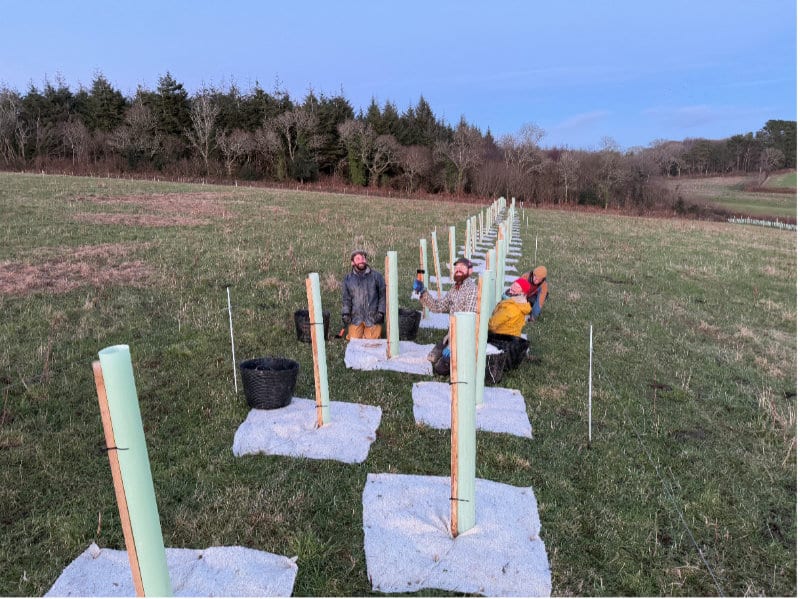
A major agroforestry scheme is already under way as part of the Plymouth and South Devon Community Forest project supported by DEFRA. The project aims to plant 15,000 trees across the farm and includes a diverse range of agroecological elements including: agroforestry strips, traditional orchard systems, hedgerows, shelterbelts, habitat corridors, willow clusters, wood pasture and successional scrub plots. In total, the planting will involve over 40 native tree species and around 20 traditional and productive fruit and nut varieties. There’s a strong emphasis on biodiversity, ecosystem services, livestock nutrition and health, all contributing to long-term farm resilience.
Organic matter is used around the tree bases which also absorbs water. Some 92 tonnes of woodchip are being distributed across the site. Willow is also gaining popularity as sheep feed. They love the leaves which have high levels of zinc and cobalt. It can therefore be managed or pollarded as a crop. Willow trees are well known for absorbing water in wet conditions and provide shelter and shade throughout the year.
Other tree crops being planted include orchard fruits and nuts, hazel and mulberry which is high in protein, easily digested and very palatable for some livestock. With one eye on a changing future and another on the lessons of the past, it certainly looks like Jacks’ and Alice’s policy of “resilience through diversity” is preparing Ramsland Farm to face the challenges that climate change will bring to farming. A message that WATER is happy to endorse.